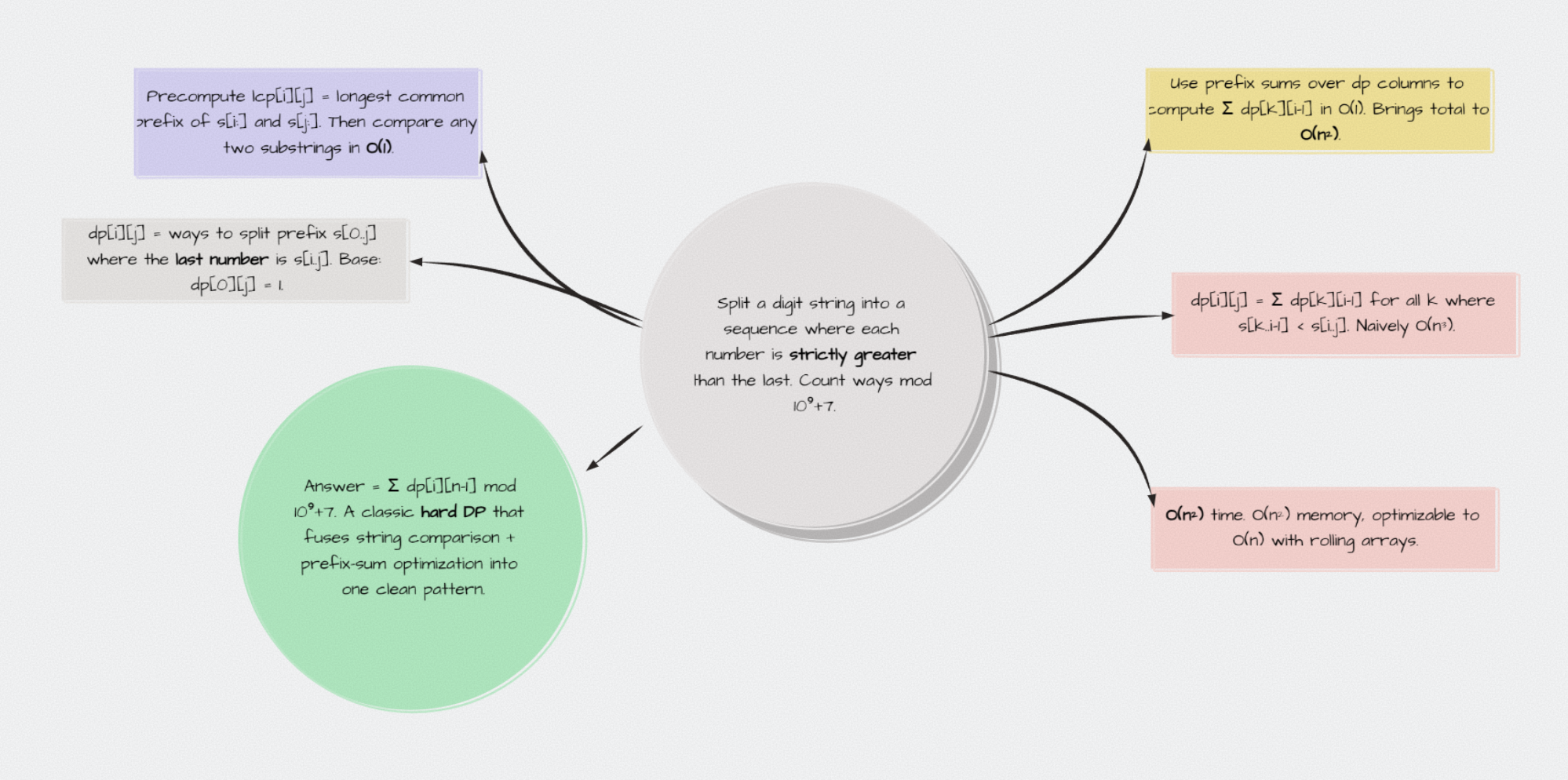
A good-to-know DP problem. It’s a combination of three classic algorithm techniques — partition DP, prefix sums, and an LCP table — which makes it a fascinating problem to study or to revise.
Let’s dive in:
Problem
Given a string num of digits, count how many ways you can split it into a
non-decreasing list of positive integers with no leading zeros.
Return the count modulo 10^9 + 7.
1 <= num.length <= 3500numconsists of digits only.
Examples:
num | answer | valid splits |
|---|---|---|
"327" | 2 | 327 and 3, 27 |
"094" | 0 | every split has a leading zero |
"9999999999999" | 101 | many |
First impression
It has vibes of a “dynamic programming” problem from the first moment we look at it. But the constraint of keeping the list non-decreasing makes us feel a bit uneasy. However, it’s hard to try a different approach without trying DP first. But why not a naive approach first? Well..
Why naive enumeration explodes
A string of length n has 2^(n-1) cut patterns. With n = 3500 that is
astronomical — we need DP. The non-decreasing constraint also depends on the
length of the previous chunk, so length has to be part of the state.
So let’s now try DP.
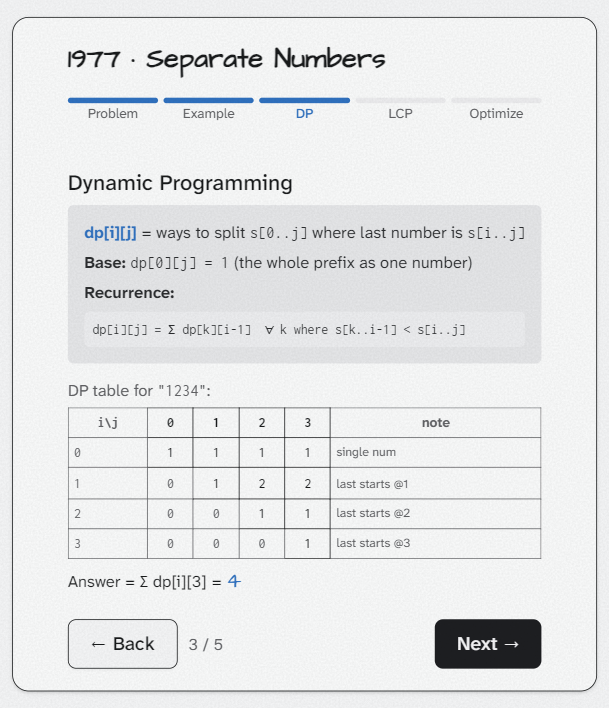
DP state
Let
dp[i][j] = number of valid splits of num[:i]
           whose last chunk has length exactly j
The current chunk occupies num[start : i] where start = i - j.
It must not start with '0'.
With this the final answer will be sum(dp[n][j] for j in 1..n).
But what is our recursive formula?
The transition formula
dp[i][j] = sum (dp[i - j][k] * (if num[i - j - k: i - j] <= num[i - j: i]))i hope the formula is clear enough. basically dp[i][j] is the sum over dp[i - j][k] of which k satisfies condition num[i - j - k: i - j] <= num[i - j: i], which is trivial, because we want non-decreasing values.
From this, we split into two cases based on k:
-
k < j— previous chunk is strictly shorter. Two positive integers with different digit counts compare by length, so the previous one is automatically smaller. No comparison needed. Sum over all suchk:dp[i][j] += dp[start][1] + dp[start][2] + ... + dp[start][j-1] -
k == j— previous chunk is the same length. Now we need a true string comparison:num[start-j : start] <= num[start : i].if num[start-j : start] <= num[start : i]: dp[i][j] += dp[start][j] -
Base case —
start == 0. The current chunk is the very first one and there is no previous chunk, sodp[i][j] = 1.
A naive implementation of this idea
def nbOfWays(num: str) -> int:
    MOD = 10**9 + 7
    n = len(num)
    dp = [[0] * (n + 1) for _ in range(n + 1)]
    dp[0][0] = 1
    for i in range(1, n + 1):
        for j in range(1, i + 1):
            if num[i - j] == '0':            # leading zero, this block is illegal
                continue
            for k in range(min(j, i - j) + 1):
                if k < j or (k == j and num[i-j:i] >= num[i-2*j:i-j]):
                    dp[i][j] = (dp[i][j] + dp[i - j][k]) % MOD
    return sum(dp[n]) % MOD
give us O(n^3) time complexity. Not bad. But we wonder if we can do better.
so looking at the solution, what makes it O(n^3) is that we have 3 loops. As our dp array is two-sized array, first two loops is expected. The third one however we can try a bit harder.
Like intuitively we can set dp[i][j] to sum of dp[i - j][k] with k from 0 -> min(j, i - j). Then whether or not we add the case dp[j][i - j] is entirely up to whether num[i-j:i] >= num[i-2*j:i-j]. Let’s optimize each.
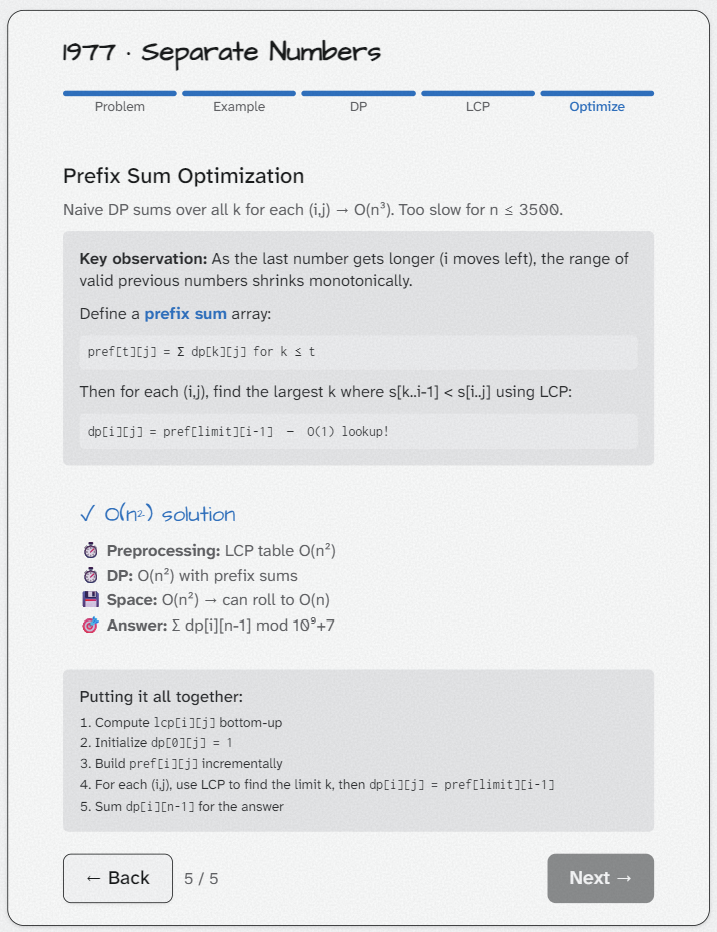
Optimization 1 — prefix sums
Define
pref[i][j] = dp[i][1] + dp[i][2] + ... + dp[i][j]Now the sum becomes a single lookup:
dp[i][j] += pref[start][j-1]Build pref[i][*] row-by-row right after finishing all dp[i][*].
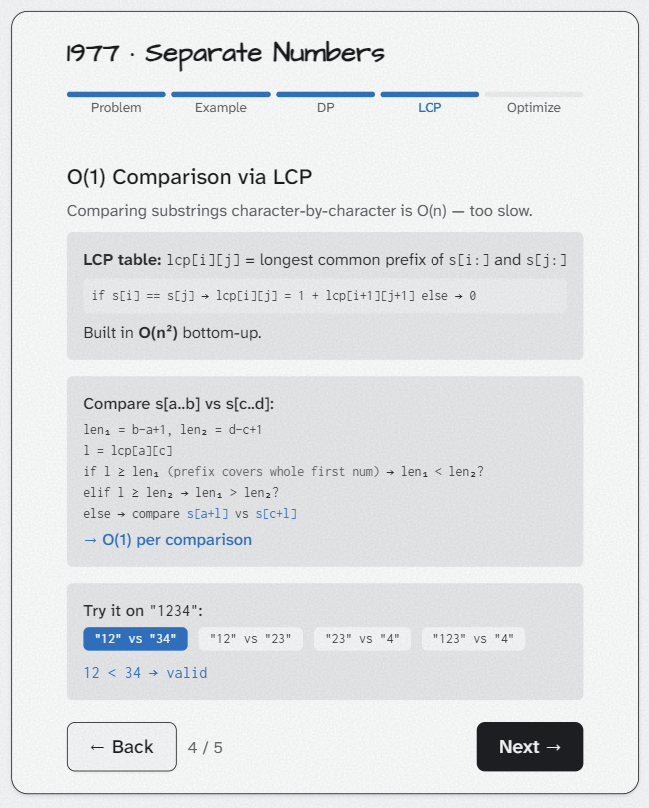
Optimization 2 — LCP table for equal-length comparison
In the second part we need to find a better way to compare two length-j substrings. Doing it character-by-character
costs O(j) and ruins the O(n^2) bound.
This is where the Longest Common Prefix of every pair of suffixes helps us:
lcp[i][j] = length of the longest common prefix of num[i:] and num[j:]Built bottom-up in O(n^2):
for i in range(n - 1, -1, -1):
    for j in range(n - 1, -1, -1):
        if num[i] == num[j]:
            lcp[i][j] = lcp[i + 1][j + 1] + 1
Then num[a:a+L] <= num[b:b+L] is O(1):
c = lcp[a][b]
return c >= L or num[a + c] < num[b + c]
If they agree on the first c >= L characters they are equal. Otherwise the
first differing character num[a+c] vs num[b+c] decides.
Final solution
With these two optimizations, we can now implement the final solution:
def nbOfWays(num: str) -> int:
    MOD = 10**9 + 7
    n = len(num)

    lcp = [[0] * (n + 1) for _ in range(n + 1)]
    for i in range(n - 1, -1, -1):
        for j in range(n - 1, -1, -1):
            if num[i] == num[j]:
                lcp[i][j] = lcp[i + 1][j + 1] + 1

    def ge(i1, l1, i2, l2):
        if l1 != l2:
            return l1 > l2
        k = lcp[i1][i2]
        return k >= l1 or num[i1 + k] >= num[i2 + k]

    dp  = [[0] * (n + 1) for _ in range(n + 1)]
    pre = [[0] * (n + 1) for _ in range(n + 1)]
    dp[0][0] = 1
    pre[0][0] = 1

    for i in range(1, n + 1):
        for j in range(1, i + 1):
            if num[i - j] != '0':
                dp[i][j] = pre[i - j][min(j - 1, i - j)]
                if j <= i - j and ge(i - j, j, i - 2 * j, j):
                    dp[i][j] += dp[i - j][j]
                    dp[i][j] %= MOD
            pre[i][j] = (pre[i][j - 1] + dp[i][j]) % MOD

    return sum(dp[n]) % MOD
Walkthrough: "327"
Initial: num[0] = '3', OK to proceed.
i | j | start | computation | dp[i][j] |
|---|---|---|---|---|
| 1 | 1 | 0 | base case | 1 |
| 2 | 1 | 1 | pref[1][0]=0; equal-len "3"<="2"? no | 0 |
| 2 | 2 | 0 | base case | 1 |
| 3 | 1 | 2 | pref[2][0]=0; equal-len "2"<="7"? yes, dp[2][1]=0 | 0 |
| 3 | 2 | 1 | pref[1][1]=1; no equal-len (start<j) | 1 |
| 3 | 3 | 0 | base case | 1 |
Answer = dp[3][1] + dp[3][2] + dp[3][3] = 0 + 1 + 1 = 2. ✅
The two surviving splits correspond to:
dp[3][2] = 1→"3", "27"dp[3][3] = 1→"327"
Complexity
- LCP table:
O(n^2)time and space - DP table + prefix sums:
O(n^2)time and space - Total:
O(n^2)time,O(n^2)space — fine forn = 3500.
Common pitfalls
-
Leading zero in the very first chunk. If
num[0] == '0'the answer is immediately0. Settingdp[1][1] = 1unconditionally is a classic bug — it sneaks a phantom split for inputs like"094"and"0". -
Comparison direction. Non-decreasing means previous <= current. Be careful which substring is
aand which isbin yourgehelper. -
Only counting previous length
j-1. A frequent mistake isdp[i][j] += dp[start][j-1], which misses lengths1..j-2. Use the prefix sum. -
Forgetting the
start == 0base case. Without it nothing seeds the DP, or you bake the seed intodp[1][1]and re-hit pitfall #1. -
Modular arithmetic. Take
% MODon every additive step. Withn = 3500and 64-bit Python ints this is fine even if you forget mid-loop, but make a habit of it.
Mental model in one line
dp[i][j]= “I’ve finished a chunk of lengthjending at positioni”; a shorter previous chunk is always OK (pref[i-j][j-1]), an equal-length previous chunk needs an LCP-powered substring compare.
The visual explainers in this article were created with dim0.net.